Standard Deviation Calculator
Understanding Standard Deviation
Standard deviation, commonly represented as sigma, is a statistical measure that quantifies how much individual values in a dataset deviate from the mean (μ). A smaller standard deviation means data points are closer to the mean, while a larger one indicates greater variability. It plays a crucial role in fields like finance, quality control, and scientific research.
Population Standard Deviation
When analyzing an entire dataset rather than a sample, the population standard deviation is used. It is derived as the square root of the variance and calculated using the following formula:
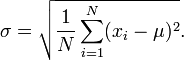
Where:
- xi - Individual data value
- μ - Mean (average) of the dataset
- N - Total number of data points
Consider the dataset: 2, 5, 7, 10, 12. To find the standard deviation:
Mean: (2+5+7+10+12) / 5 = 7.2
sigma = √[(2 - 7.2)2 + (5 - 7.2)2 + ... + (12 - 7.2)2]/5
sigma ~ 3.87
Sample Standard Deviation
If we analyze a subset of data rather than the entire population, we use the sample standard deviation, denoted by s. The key difference is the division by (N-1) instead of N, correcting for bias in smaller samples.
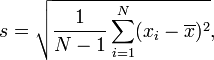
Where:
- xi - A data value in the sample
- x̄ - Sample mean
- N - Sample size
Applications of Standard Deviation
Standard deviation is widely applied across various industries, including:
- Quality Control: Ensuring consistency in product manufacturing.
- Weather Analysis: Comparing climate variations across regions.
- Finance: Assessing investment risks based on price fluctuations.
Understanding standard deviation helps in making data-driven decisions, offering insights into variability, predictability, and trends within datasets.